The Great Crises
Three Plagues: Oïdium, Phylloxera and Mildew (1851–1900), in Data
How three imported vine diseases reshaped Bordeaux between 1851 and 1900 — oïdium, phylloxera and mildew — and the treatments that answered each.
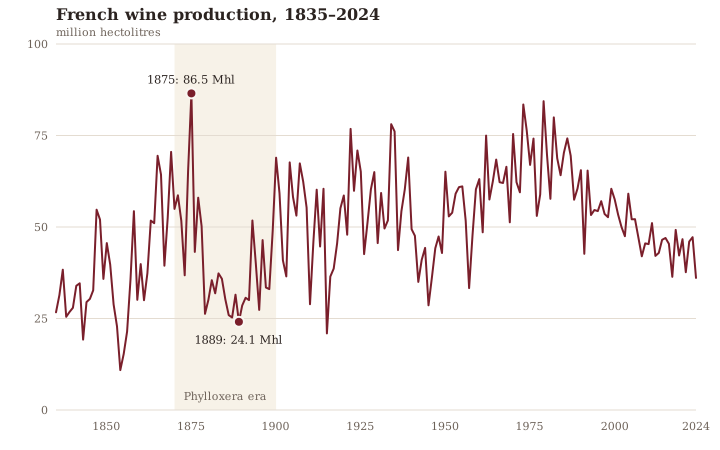
The second half of the nineteenth century was, for the Bordeaux vineyard, a sequence of biological shocks. Three diseases — none of them native to Europe — arrived in turn between the early 1850s and the 1880s, and each forced growers to invent or import a new defence. The story is told anecdotally everywhere: the American aphid, the flooded vineyards, the copper-blue leaves. It is charted almost nowhere. Set against the long series of French wine production assembled by Anderson and Pinilla, the trilogy stops being a collection of anecdotes and becomes a single, measurable rupture — the moment when European viticulture had to be rebuilt from the roots up.
Oïdium: the first warning (early 1850s)
The first of the three plagues was oïdium, or powdery mildew, a fungus of North American origin that spread through French vineyards in the early 1850s. It coated leaves and berries in a grey bloom, split the fruit and could gut a harvest. It was also the first of the three to be answered. Growers found that dusting the vines with sulfur — flowers of sulfur applied as a powder — checked the fungus effectively, and the treatment was established within a few years of the outbreak. Oïdium never disappeared, but it became a managed nuisance rather than a catastrophe. In hindsight it was a rehearsal: it taught the vineyard that an imported disease could be met with an imported or invented remedy, and that the remedy had to be applied every season, to every vine. It also set the pattern for what followed. Each of the three plagues came from across the Atlantic, each exploited a European vine with no evolved defence against it, and each was ultimately contained not by a single discovery but by a routine — a treatment folded into the annual calendar and repeated in perpetuity. Oïdium was the mildest of the three only in retrospect; at the time it was frightening enough, and the speed of the sulfur answer flattered the vineyard into believing the next intruder would yield as readily.
Phylloxera: a thirty years' war
The second plague admitted no such quick answer. Phylloxera vastatrix, a tiny sap-sucking aphid from the eastern United States, attacks the roots of the European vine, Vitis vinifera, and kills it. It was identified in southern France at the end of the 1860s and spread through the Gironde during the 1870s, moving vine by vine and commune by commune. Because the insect worked underground, the damage was often advanced before it was understood; a vine would weaken and die with no visible cause above the soil.
The historian Gilbert Garrier called the fight against it une guerre de trente ans — a thirty years' war, running from roughly 1870 to 1900 — and the phrase captures both its length and its improvised, front-by-front character. Growers tried in succession nearly everything. Vineyards low enough to be flooded could drown the insect under winter submersion, but only a minority of sites allowed it. Carbon disulfide, injected into the soil as an insecticide, slowed the aphid where growers could afford the chemical and the labour, without ever eradicating it. Neither was a cure.
The solution, when it came, was botanical rather than chemical: grafting the productive European vine onto the roots of American Vitis species, which had evolved alongside phylloxera and tolerated it. Reconstitution of the vineyard on resistant American rootstock became the definitive answer, and it is the one still in use across Bordeaux — and the wine world — today. But grafting meant tearing out and replanting the entire vineyard, vine by vine, at enormous cost and over many years. That is why Garrier's "war" lasted a generation.
The fight was not only agronomic. Prizes were offered for a cure, learned commissions convened, and rival camps — the sulfuristes who trusted chemistry and the américanistes who trusted grafting — argued the question out across the 1870s and 1880s before American rootstock carried the day. Garrier's monograph treats the episode as a social and economic upheaval as much as a botanical one: the reconstitution redistributed labour, capital and knowledge across the vineyard, rewarding growers who could raise the money to replant and ruining those who could not.
Mildew: the third arrival (1880s)
The vineyard was still replanting when the third plague arrived. Downy mildew (Plasmopara viticola), another North American import, appeared in France in the 1880s — carried, in one of the crisis's bitter ironies, on the very American vines being brought in to fight phylloxera. Unlike powdery mildew, it thrived in damp Atlantic weather, exactly the conditions of the Gironde, and could destroy the foliage of a healthy young vine.
Its remedy was found in the Bordeaux vineyard itself, and it is one of the most celebrated details in the history of plant protection. Growers near Bordeaux had taken to painting the vines along roadsides with a blue-green mixture of copper sulfate and lime, to deter passers-by from stealing the grapes — and it was noticed that these treated vines resisted mildew. Formalised in the 1880s, the mixture became bouillie bordelaise — Bordeaux mixture — the first widely used fungicide, named for the region where it was developed and still used, in refined form, worldwide. Where phylloxera forced a botanical solution, mildew was answered chemically, and the annual copper spray joined sulfur dusting as a permanent fixture of the growing year.
The economic sequence, 1870–1911
The plagues did not act on the market in a simple straight line, and the clearest account of their economic aftermath is James Simpson's study of France's domestic wine markets between 1870 and 1911. Simpson traces a sequence rather than a single slump. Phylloxera first produced scarcity: as production fell, wine became dear and prices rose. That scarcity, in turn, drew in wine from elsewhere — imports and newly planted regions — and encouraged adulteration, the stretching or faking of wine to meet demand at the high prices. Then, as the replanted vineyards came back into bearing and the imports kept flowing, scarcity turned into its opposite: overproduction, falling prices, and a glut. The disease that had begun as a shortage ended as a surplus, and in the span of a single generation France's wine markets were transformed.
What changed for good
By 1900 the vineyard that emerged from the three plagues was not the one that had entered them. Every vine of quality now grew on grafted American rootstock, a structural change that has never been reversed. The costly, all-at-once replanting encouraged growers to consolidate around fewer, proven grape varieties, narrowing the ampelographic diversity of the region. And the wave of adulteration and fraud that Simpson describes — the flood of stretched, imported and mislabelled wine — created the pressure that would, in the following decades, push France toward the legal definition of origin and the appellation system. That is a separate story. But its origins lie here, in the thirty years' war and the two fungal plagues that bracketed it.
Sources
- Gilbert Garrier, Le Phylloxéra — une guerre de trente ans, 1870–1900 (Albin Michel, 1989, ISBN 2-226-03879-5)
- James Simpson, Phylloxera, Price Volatility and Institutional Innovation in France's Domestic Wine Markets, 1870–1911 (IFCS WP wh044602, 2004)
- Anderson & Pinilla, Annual Database of Global Wine Markets, University of Adelaide