The 20th Century
Two Wars and a Slump: Bordeaux from 1914 to 1945
How Bordeaux lived through 1914–1945 — the pinard ration, the unsold 1930s, AOC rules born mid-crisis, the weinführer years and the frost of 1945.
In 1914 the Bordeaux vineyard had just spent forty years and a fortune rebuilding itself from phylloxera, oïdium and mildew. What followed was worse: two world wars, a decade-long depression, an occupation, and the coldest commercial winter in the region's modern history. The geographer Philippe Roudié, whose Vignobles et vignerons du Bordelais (1850–1980) remains the standard account of the period, treats these three decades as one long ordeal running from the trenches to the Liberation. Yet the era that nearly ruined Bordeaux also built much of its modern architecture: the appellation system was written in the middle of the slump, the trade's governing body emerged from the war, and a surprising number of today's family estates were founded at the bottom of the market, when vines were something you acquired because no one else wanted them.
1914–1918: the republic of pinard
The First World War made France's army the largest wine customer in history. Wine entered the soldier's official ration in October 1914 at a quarter of a litre a day; the ration was doubled in January 1916 and raised to three-quarters of a litre in January 1918, according to the French agriculture ministry's own account. Supplying it became a state enterprise. As the historian Alban Sumpf describes, the army's supply services collected, processed and moved millions of hectolitres, filling the gap between donations and discounted purchases with requisitions that could claim up to a third of some harvests. Pinard — the soldiers' rough, anonymous red — became a patriotic institution, celebrated in song and credited with holding the front together.
Little of that pinard was claret, and the pinard economy was not Bordeaux's economy. The Gironde's business rested on selling named wines abroad, and the war attacked it from the other side: mobilization emptied the vineyards of their men, leaving women, the old and the young to prune and treat the vines, while shipping and export markets were disrupted for four years. The region's symbolic moment came early — in September 1914 the French government itself withdrew from Paris to Bordeaux — but the vineyard came out of the war intact and impoverished, its workforce depleted and its customers scattered.
The false recovery of the 1920s
Peace did not bring the old world back. Revolutionary Russia, once a prestige market for Bordeaux's sweet and classified wines, was gone; Prohibition closed the United States from 1920 to 1933. What the 1920s did deliver, at the very end, was quality: 1928 produced dark, tannic wines built for decades, and 1929 was hailed as one of the vintages of the century, with harvest beginning on 18 September under near-perfect conditions, as Jane Anson's vintage-by-vintage survey records.
The timing could hardly have been crueller. The Wall Street crash came on 24 October 1929, weeks after the grapes were picked. Two celebrated vintages, made at real expense, arrived on a market that was ceasing to exist.
The miserable thirties
Then nature joined in. 1930 brought rain, coulure and widespread downy mildew, and a small crop of poor wine. 1931 was cold and sodden — 21 days of rain in August alone. 1932 was worse still: a harvest that began on 20 September yielded around half a normal crop, of poor quality. Three failed vintages in a row, in the middle of a world depression, pushed the region into open crisis; contemporary vintage records note that classified estates began to be put up for sale. Responses that now look visionary were born of simple desperation: at Mouton, Baron Philippe de Rothschild launched Mouton Cadet in 1930 as an outlet for wine the grand vin could not use.
The market offered no rescue, because France was drowning in wine from elsewhere. Algeria, then legally part of France, had pushed its production to some 20 million hectolitres by 1935, and by the mid-1930s accounted for roughly two-thirds of the entire world's wine exports — almost all of it shipped duty-free into mainland France, as the economists Giulia Meloni and Johan Swinnen have shown. Even the French themselves, drinking more wine in 1934 than at any moment before or since — some 170 litres per person per year — could not absorb the surplus.
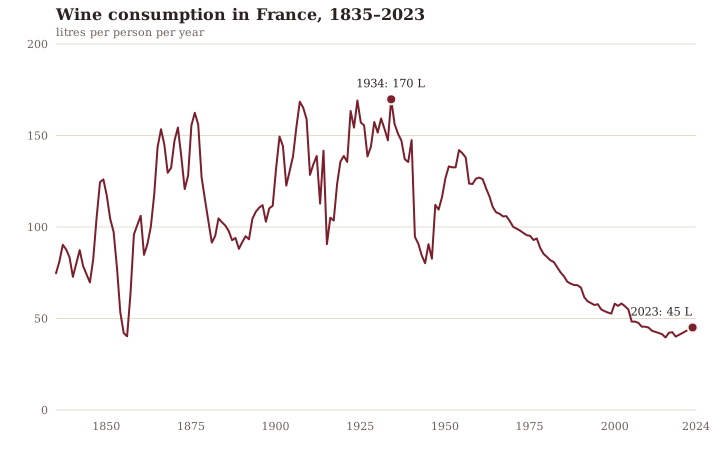
Prices and land values tell the rest of the story, and it is told most plainly at the top. In May 1935 Château Haut-Brion — a first growth of 1855, its owner close to bankruptcy and the estate in a dilapidated state — was sold to the American banker Clarence Dillon for 2,300,000 francs. Jean-Michel Cazes, remembering the Médoc his family bought into, put it bluntly: revenues were low, the buildings were run down — "they were farms", and much of the peninsula remained for sale into the 1950s. The longer arc of these prices is charted in our economics of Bordeaux in charts.
But cheap land cuts two ways. A vineyard no investor wanted was a vineyard a farming family could finally afford, and the depression quietly transferred hundreds of properties from distressed owners to the smallholders and local families who would farm them through the century. Many of today's family estates date from precisely this unglamorous decade — Château de Brague in the Fronsadais, founded in 1937, among them.
Rules written at the bottom: the AOC arrives
It is one of the ironies of Bordeaux history that its quality framework was not born in a golden age but at the bottom of the worst slump the region had known. The décret-loi of 30 July 1935, promoted by the Gironde senator Joseph Capus as a measure for "the defence of the wine market", created the Comité National des Appellations d'Origine — the future INAO — and with it a new legal object: the appellation d'origine contrôlée, defined by delimited area, grape varieties, yields and minimum ripeness. The first six AOCs were decreed on 15 May 1936; Bordeaux followed within months, with Sauternes and Barsac recognized on 11 September 1936 and Margaux, Pauillac and Saint-Émilion among the wave of decrees of 14 November 1936. Meloni and Swinnen read the whole edifice partly as a defensive wall against the Algerian flood. The decades of fraud and failed laws that led up to it are a story of their own.
Occupation: the weinführer years
When France fell in June 1940, the Reich organized the exploitation of the French vineyard with bureaucratic precision. As Don and Petie Kladstrup recount in Wine and War, a weinführer — a wine-trade plenipotentiary, usually drawn from the German wine business — was assigned to each region: Otto Klaebisch to Champagne, and to Bordeaux Heinz Bömers, head of the Bremen firm Reidemeister & Ulrichs, whose family had owned Château Smith Haut Lafitte until France confiscated German property after the First World War. The historian Christophe Lucand, in Le vin et la guerre, describes the system these men ran as the most intense organized plunder the French vineyard had ever known, conducted through purchases at dictated terms with Vichy as intermediary, and hardening sharply from 1942.
In Bordeaux the arrangement had a bitter twist: the occupier was also the only customer left, Britain and America being closed to trade. Bömers bought enormously — including, as Jane Anson notes, lots equivalent to a million bottles of the unsold, mediocre stocks of the 1930s, so that the depression's leftovers ended their career in German canteens. Growers hid their best wine behind hastily built cellar walls aged with dust and spiders, and Bömers himself, the Kladstrups report, once filled an order from Göring's circle with ordinary wine under counterfeit Mouton labels. Others collaborated outright. The city's most powerful merchant, Louis Eschenauer, did business worth 957 million francs during the war by his own admission, acquired seized Jewish-owned estates through his Société des Grands Vins Français, and entertained the occupiers at the Chapon Fin; tried from 9 November 1945, he was convicted of economic collaboration and sentenced to two years in prison and a fine of over 60 million francs. By late 1944 some 43 Bordeaux merchants faced proceedings and sequestration; most were amnestied by 1950–51. One durable institution emerged from the wreckage: the wartime trade committee created in January 1944 became, on 22 February 1945, the Conseil Interprofessionnel du Vin de Bordeaux.
1945: frost, victory, and a vineyard on its knees
The war in Europe ended on 8 May 1945. A week earlier, on the night of 1 May, a savage frost had destroyed more than half of the Gironde's potential crop; the harvest came in at roughly 1.5 million hectolitres, the region's smallest since 1915. A hot, dry summer concentrated what survived, and the tiny "victory vintage" — bottled at Mouton under a label reading Année de la Victoire — turned out to be one of the greatest of the century, made largely by the women, old men and children who had kept the vines alive through the war years.
It was a glorious wine from a broken vineyard. In 1945 Bordeaux's estates were undercapitalized farms with worn-out equipment, depleted of men and money, and the market would stay bad for another decade: the low ebb that began in 1930 did not truly lift until the late 1950s. But the survivors of these thirty years — the AOC rules of 1935–36, the CIVB, and the families who had bought land when land was worthless — were precisely the foundations on which the region's post-war boom would be built.
Sources
- Philippe Roudié, Vignobles et vignerons du Bordelais (1850-1980) — review by Annales de Géographie, Persée
- Alban Sumpf, "Le vin et l'armée", L'Histoire par l'image (RMN-Grand Palais)
- Ministère de l'Agriculture, "Que mangeaient les poilus ?"
- Giulia Meloni & Johan Swinnen, "The Rise and Fall of the World's Largest Wine Exporter", Journal of Wine Economics 9(1), 2014
- INAO, "90 years of AOC — the first six appellations d'origine contrôlée"
- Vitisphere, "Les vins AOC ont 90 ans", with the 1936 recognition decrees
- Jane Anson, "The Vintages — 1855 onwards", Inside Bordeaux
- Château Mouton Rothschild, official history (Baron Philippe, Mouton Cadet)
- The Wine Cellar Insider, Château Haut-Brion profile (1935 sale)
- Jean-Michel Cazes on Bordeaux's great crises, Vitisphere interview
- Christophe Lucand, Le vin et la guerre. Comment les nazis ont fait main basse sur le vignoble français (Armand Colin, 2017)
- Don & Petie Kladstrup, Wine and War (Broadway Books, 2001)
- Jane Anson, "Wine and War — chasing the weinführers", Inside Bordeaux
- Jane Anson, "Uncle Louis — the untold story", Inside Bordeaux
- Rue89 Bordeaux, "Vins de Bordeaux — sous l'occupation allemande, les affaires n'ont pas cessé"
- The Wine Cellar Insider, 1945 Bordeaux vintage report
- The National WWII Museum, "Mouton Rothschild and the 1945 Victory Vintage"
- Anderson & Pinilla, Annual Database of Global Wine Markets, University of Adelaide