Bordeaux Today
Bordeaux Today: Too Much Wine, Fewer Drinkers, a Warmer World
Overproduction, subsidized uprooting, climate stress and new grapes — Bordeaux's 2020s crisis in verified numbers and historical perspective.
Since the autumn of 2023, excavators have been working through the vineyards of the Gironde, pulling vines out by the roots — not because the vines are sick, for the most part, but because nobody will buy their wine at a price that covers the cost of making it. Between August 2023 and May 2026, roughly 21,000 hectares of Bordeaux vineyard were uprooted, by the count of the French agriculture ministry's regional statistics service — about a fifth of the vineyard as it stood at the start of the decade. It is the most dramatic contraction in the region's modern history, and it is happening at public expense, with the state and the wine trade paying growers to remove vines permanently. To understand how the world's most famous wine region arrived here, you need three stories at once: a home market that has been dying for ninety years, an export bet that went wrong, and a climate that is rewriting the rules of the vineyard itself.
The customer who stopped drinking
The deep cause of the crisis is not a bad harvest or a bad decade. It is the slow disappearance of the French wine drinker.
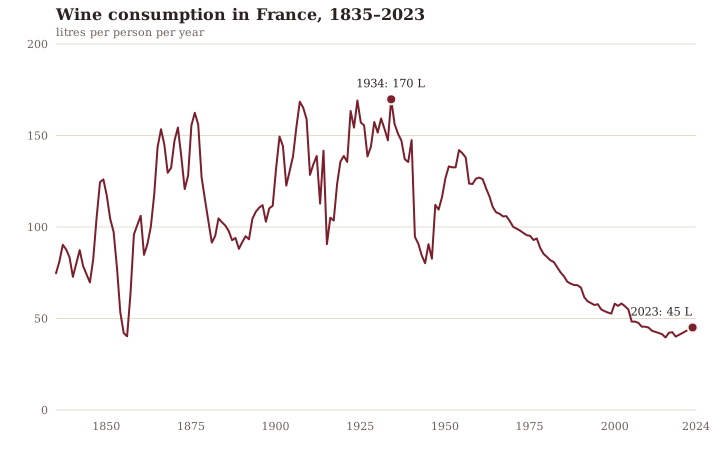
In 1934, the average French person drank 170 litres of wine a year; in 2023 the figure was 45 litres, according to the Anderson & Pinilla long-run series. Nearly three quarters of the domestic market has evaporated in three generations, as wine moved from daily staple to occasional choice — a structural shift traced in detail in The Economics of Bordeaux Wine in Charts. And within that shrinking market, the decline is steepest exactly where Bordeaux is strongest: everyday red wine. Younger French consumers drink less wine than their parents, less often, and less of it red. The Gironde's own production tells the story: red wine made up about 90 per cent of the department's volumes a decade ago and 83 per cent in 2025, per the regional agriculture statistics service (DRAAF Nouvelle-Aquitaine) — still an overwhelmingly red region, selling into a market that wants steadily less red.
Selling below cost
For the generic end of the market, the arithmetic stopped working in the early 2020s. Bordeaux's bulk wine trades by the tonneau of 900 litres, and the interprofessional body, the CIVB, publishes the going rates. In the spring of 2024, generic red Bordeaux changed hands at an average of 946 euros per tonneau; for the 2025–26 campaign (August 2025 to June 2026) the CIVB's average for conventional red was 880 euros — less than one euro per litre for wine from the world's most famous appellation. Trade analyses published by Vitisphere have repeatedly found these prices below the cost of production, meaning that a significant share of Bordeaux's growers lose money on every vintage they sell in bulk.
The export markets that were supposed to absorb the surplus have receded instead. China was the great hope of the 2010s: by 2017 it took 20 per cent of Bordeaux's exports — around 80 million bottles a year at the peak, making it the region's largest export market, according to CIVB figures. As of 2025 those shipments had halved, to roughly 40 million bottles, undercut by China's economic slowdown and changed drinking habits. A region that had planted and priced for Chinese demand found itself, within a few years, with the wine and without the buyer.
Paying growers to uproot
The response, as so often in French wine crises, was organized retreat. In April 2023 the CIVB's general assembly voted a 57-million-euro plan to uproot up to 9,500 hectares in the Gironde, at 6,000 euros per hectare — 38 million from the state, 19 million from the interprofession itself — formally framed as a sanitary measure against the spread of flavescence dorée through abandoned vines. In October 2024 the government followed with a national scheme at 4,000 euros per hectare, budgeted at 120 million euros; when applications closed that November, FranceAgriMer had received 5,418 applications covering 27,461 hectares across France, with roughly a quarter of applicants declaring they were leaving wine production entirely.
The cumulative effect on the Gironde is stark. The DRAAF's 2026 statistical portrait counts 12,284 hectares removed under the aided schemes by May 2026, plus an estimated 8,700 hectares uprooted without aid — about 21,000 hectares in under three years. The Gironde's productive vineyard stood at 91,543 hectares in 2025, down 9,200 hectares in that single year and down 27,000 hectares (−23 per cent) since 2010, with roughly 8,000 more hectares expected to go in 2026–27. The human contraction runs parallel: the department counted about 3,000 wine-growing holdings in 2024, 18 per cent fewer than in 2019. Nothing on this scale has happened since phylloxera — though, as the long-run data show, subsidized uprooting itself is a recurring French instrument, not a Bordeaux invention.
The climate squeeze
Behind the market crisis runs a slower one. Average temperatures in Bordeaux have risen by about 2 °C since 1950, according to Météo-France data. Across France, grape harvests now begin about two weeks earlier than the historical norm: a 2016 study in Nature Climate Change by Benjamin Cook and Elizabeth Wolkovich, using harvest records reaching back to 1600, found that since the 1980s warming alone — no longer just drought years — has been pulling harvests forward. Riper grapes mean stronger wine: where red Bordeaux commonly reached 12 to 13.5 per cent alcohol a generation ago, 14 to 14.5 per cent is now routine, as reporting by the Washington Post documented in 2020 — a style drifting away from the freshness the market increasingly asks for.
The 2020s have also delivered a run of brutal vintages. 2021 brought severe spring frost and mildew; 2022 was the hottest, driest season in recent memory; 2023 saw the worst mildew pressure in a quarter-century, by the assessment of the annual crop reports published on JancisRobinson.com. In 2024, frost, mildew and a shrinking vineyard combined to produce just 3.3 million hectolitres — Bordeaux's smallest harvest since 1991, per the CIVB, down 14 per cent on 2023. The 2025 harvest, on the reduced vineyard, came in at 3.2 million. Overproduction and short harvests sound like opposite problems; Bordeaux currently has both, because demand has fallen even faster than supply.
New grapes, whiter wines
Adaptation is under way, on two fronts. In January 2021 the INAO, France's appellation authority, authorized six new grape varieties for the Bordeaux and Bordeaux Supérieur appellations, selected from 52 candidates studied for a decade for drought resistance and later ripening: the reds Arinarnoa, Castets, Marselan and Touriga Nacional — the last borrowed from the Douro — and the whites Alvarinho and Liliorila. The authorization is deliberately cautious: at most 5 per cent of an estate's area and 10 per cent of any blend. It is nonetheless a historic opening of a variety roster that had been effectively frozen for a century — the latest turn in a long story of change told in A History of Bordeaux's Grape Varieties.
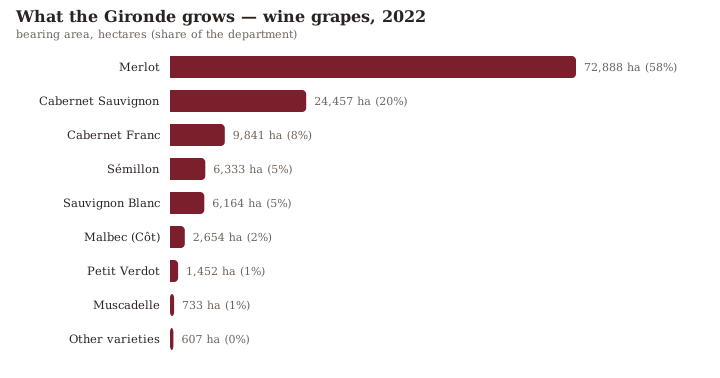
The chart shows what is at stake: as of 2022, Merlot alone covered 58 per cent of the Gironde's vines — the earliest-ripening of the region's major red grapes, and therefore the most exposed to further warming. The other front is color. While generic red struggles, Crémant de Bordeaux, the region's traditional-method sparkling wine, grew 57 per cent in volume in 2022 alone, to 91,000 hectolitres from 1,345 hectares, with volumes multiplied five-fold in a decade. Dry whites hold up better than reds, and growers are converting red parcels to white and sparkling production. But proportion matters: crémant is still only about one per cent of Bordeaux's volume. It is a lifeline for some growers, not a solution for a region.
Has Bordeaux survived worse?
It has, repeatedly — and that is the honest frame for the present crisis, neither consolation nor doom. In the 1880s, phylloxera and the mildews destroyed the vineyard's very roots, and French production fell by more than two thirds; the region rebuilt itself on grafted vines. In the seventeenth century it reinvented its products wholesale for Dutch buyers; in the twentieth it pivoted from a vanishing home market to export. The historical lesson of those episodes is not that recovery is automatic. It is that Bordeaux has never been saved by its terroir alone: each time, survival came from finding new customers and changing what the vineyard grew for them. That is precisely the test the 2020s have set — with the added, novel constraint that this time the climate itself is moving. The uprooting now under way is painful, but the long series suggest how to read it: not as the end of Bordeaux, but as the region shrinking to fit the market that actually exists, as it has done before. What it grows on the hectares that remain — whiter, fresher, partly from grapes no eighteenth-century broker would recognize — will decide what Bordeaux means in 2050.
Sources
- DRAAF Nouvelle-Aquitaine / Agreste, "La filière viticole girondine", Essentiel n°80, édition 2026
- Vitisphere, "L'interprofession des vins de Bordeaux vote un plan d'arrachage à 57 millions € pour 9 500 hectares" (April 2023)
- Vitisphere, "27 451 ha de vignes à arracher définitivement" — FranceAgriMer national scheme results (2024)
- Vitisphere, "946 € le tonneau, le CIVB republie les cours du vin en vrac de Bordeaux" (2024)
- Vino Joy News, "Bordeaux Wine Production Hits Lowest Level Since 1991" — CIVB figures (February 2025)
- The Drinks Business, "Chinese owners offload Bordeaux estates as demand slumps" — CIVB export figures (April 2025)
- The Drinks Business, "INAO approves six new grapes in Bordeaux" (January 2021)
- Cook & Wolkovich, "Climate change decouples drought from early wine grape harvests in France", Nature Climate Change (2016)
- Undark, "For Bordeaux's Winemakers, Rising Temperatures Bring a Reckoning" — Météo-France temperature data (2018)
- The Washington Post, "In Bordeaux, warming temperatures threaten a world-renowned wine" (2020)
- Gavin Quinney / JancisRobinson.com, Bordeaux weather and crop reports (2023, 2024)
- Vitisphere, "Le crémant de Bordeaux ne connaît pas la crise, mais 57 % de croissance" (2023)
- Anderson & Pinilla, Annual Database of Global Wine Markets, University of Adelaide