Themes
The Grapes of Bordeaux: Two Thousand Years of Changing Varieties (with Data)
From the Roman grape Biturica to a Merlot-dominated vineyard: how the varieties of Bordeaux changed over two thousand years, with modern data.
In 2022, Merlot covered 58.3% of the Gironde's bearing vineyard. The usual modern answer to "what grows in Bordeaux" (Merlot and the two Cabernets for red, Sémillon and Sauvignon for white) describes that vineyard accurately, but it is a recent arrangement. The varieties planted along the Garonne have been replaced several times in two thousand years, under pressure from climate, trade, disease and fashion. The vineyard of 2022 is not the vineyard of 1850, and even less the vineyard of the Roman town. For most of the period, though, nobody recorded vines by name. Counts by variety exist only for the last few decades.
Biturica
The first Bordeaux vineyard dates from the first century AD, and it was planted with one grape. In Book XIV of his Natural History, written in the 70s AD, Pliny the Elder describes a variety called Biturica, named after the Bituriges Vivisci, the Celtic people who founded Bordeaux. Its advantage was hardiness. It withstood frost, wind and rain, and it ripened in the damp Atlantic climate where the Mediterranean vines had failed.
Ampelographers treat Biturica as a probable ancestor of the Cabernet family. The qualifier matters: the link rests on a chain of names and shared traits, not on a laboratory pedigree. If it holds, the grapes that define Bordeaux today descend from the one it started with. The Roman period is covered in The Roman Origins of Bordeaux Wine. The point to keep from it here is that the first vineyard was built around a grape chosen for the local climate.
Medieval wine: colour, not variety
For roughly a thousand years afterwards, the documents say almost nothing about grapes. Customs accounts, sale contracts and monastic surveys identify wine by its style and colour. They separate clairet, the pale, light red that was the region's ordinary wine, from white wine, and later from the darker, more concentrated wines kept for ageing. They almost never name the vine.
The gap in the archive reflects how people thought about wine at the time. The idea that a wine is defined by one named variety, that a bottle is "a Merlot" or "a Cabernet", is largely modern. Medieval growers planted mixed vineyards of whatever did well locally, picked them together, and judged the result by colour and quality. A modern grape map projected onto the Middle Ages imposes a category the period did not use.
Before phylloxera: more varieties
By the eighteenth and nineteenth centuries the varieties come a little more into view, and there were more of them than there are now, grown in different proportions. Malbec, known locally as Côt, noir de Pressac or Auxerrois, was planted widely across Bordeaux and ranked among the region's main red grapes before the disease years. Today it is a minor blending variety. Carmenère and other grapes now rare in the Gironde were part of the ordinary mix.
Cabernet Sauvignon rose within that mix. It is a relatively young variety, a natural cross of Cabernet Franc and Sauvignon Blanc, and over the eighteenth and nineteenth centuries it became closely tied to the great estates of the Médoc, as those properties were assembled and built their reputations. The dates are uncertain. What the sources support is a trend: Cabernet Sauvignon gaining ground on the Médoc gravels as the estate system matured. They do not give a year, or a share of plantings. No reliable census of varieties survives from the pre-phylloxera vineyard, so this period has no figures.
Phylloxera and the narrowing
Phylloxera, an aphid that spread through the Gironde in the 1870s, killed European vines at the root. The whole vineyard had to be pulled up and replanted, vine by vine, grafted onto resistant American rootstock. The three epidemics of the period and the treatments for each are covered in Three Plagues: Oïdium, Phylloxera and Mildew.
For the choice of varieties, the replanting was decisive. Rebuilding a vineyard by hand cost a fortune, and growers paying that price chose fewer and safer varieties: ones that took well to grafting, cropped reliably and found buyers. Grapes that were awkward to grow, low-yielding or hard to sell lost ground in the Gironde and never fully recovered it. Malbec and Carmenère were among them. Reconstruction and standardisation happened together.
The twentieth century in figures
Counts by variety become usable only in the twentieth century, and the best long series is national rather than regional. The Anderson and Nelgen database at the University of Adelaide reconstructs the bearing area of each winegrape variety in France.
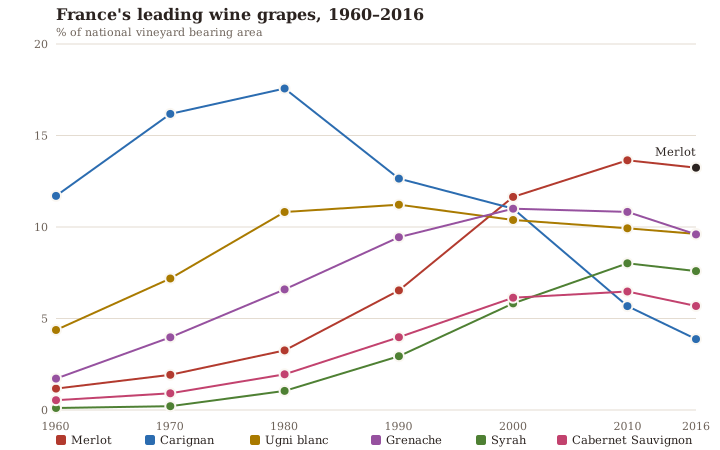
In 1960 France's largest variety was Carignan, listed in the database under its Spanish name, Mazuelo. It peaked at 17.6% of the national bearing area in 1980, with Ugni blanc and Grenache also near the top. By 2016 Merlot ranked first, at 13.2% of the national bearing area. Over the same period France's total bearing area fell from about 1.45 million hectares in 1960 to about 820,000 hectares in 2016, so the vineyard shrank as well as changing its varieties.
The second chart ranks the top eight varieties at each census. Where two lines cross, one variety has overtaken the other.
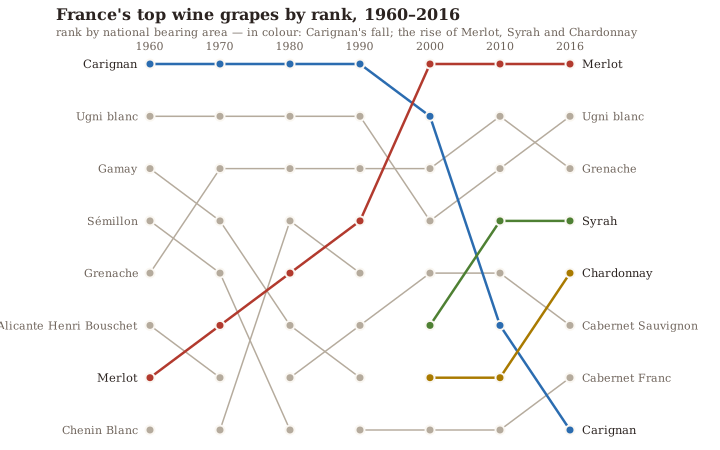
These are national figures, not figures for Bordeaux. Carignan's decades at the top belong to the Languedoc, the large southern vineyard, not to the Gironde. Merlot's rise is different. Its home is the Bordeaux right bank, in Fronsac, Saint-Émilion, Pomerol and the neighbouring appellations, where it is the main grape. When it became the most planted variety in France, a Bordeaux grape had reached first place.
The Gironde in 2022
The regional figures show how far the vineyard has narrowed, and how red it has become.
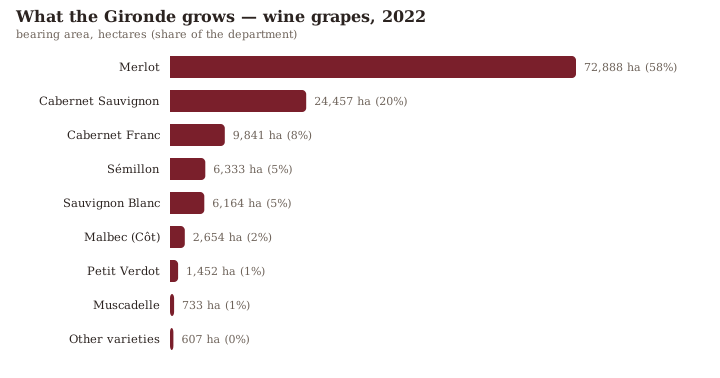
The Gironde's bearing area in 2022 splits as follows: Merlot 58.3%, Cabernet Sauvignon 19.5%, Cabernet Franc 7.9%, Sémillon 5.1%, Sauvignon blanc 4.9%, Malbec/Côt 2.1%, Petit Verdot 1.2% and Muscadelle 0.6%. Red varieties make up roughly 87 to 89% of the vineyard. Modern Bordeaux is a red-wine region, and Merlot leads it.
It was not always so. Large parts of the Gironde once grew mostly white grapes. In the seventeenth and eighteenth centuries, Dutch buyers pushed the vineyard towards white wine: plain whites for distilling into brandy, and the sweet whites on which the region's first reputation for quality was built. That shift is the subject of The Dutch Revolution in Bordeaux Wine. White grapes then held a far larger share than the roughly one in ten they hold now. The sources do not allow that share to be put in figures with any confidence, or mapped precisely; they establish the direction of change. Red dominance in the Gironde is recent.
Climate
In 2021 the Bordeaux appellations authorised a set of new heat-adapted varieties, Touriga Nacional from the warm Douro among them, in response to a warming climate. This is recent regulatory experimentation. The varieties are allowed only in small, capped proportions, and growers and winemakers are still testing them. Nobody can yet say whether they will become a lasting part of Bordeaux's range or disappear. The decision does repeat the first one on record. Pliny's Biturica was chosen because it could survive the Atlantic cold; two thousand years later, the growers are choosing grapes that can survive heat, on the same principle of planting what the climate and the market will bear.
Sources
- Pliny the Elder, Natural History, Book XIV
- Kym Anderson & Signe Nelgen, Database of Regional, National and Global Winegrape Bearing Areas by Variety (Wine Economics Research Centre, University of Adelaide)
- Roger Dion, Histoire de la vigne et du vin en France des origines au XIXe siècle (1959; CNRS Éditions, 2010)
- Gilbert Garrier, Le Phylloxéra — une guerre de trente ans, 1870–1900 (Albin Michel, 1989, ISBN 2-226-03879-5)