Themes
The Economics of Bordeaux Wine in Charts (1305–2024)
Seven centuries of wine economics in verified numbers: medieval export records, the phylloxera collapse, the consumption crash and the export pivot.
In 1308–09 the port of Bordeaux shipped 102,724 tonneaux of wine. In 1934 the average French person drank 170 litres of wine a year; in 2023, 45. Between those two figures lies most of what can be measured about the Bordeaux wine economy, and there is more of it than for almost any other wine region, because two unusually long statistical records meet here. The first is a medieval customs register that begins in 1305 and ranks among the richest trade series of the European Middle Ages. The second is the set of national series on production, consumption, trade and vineyard area for France since the nineteenth century, assembled by the economists Kym Anderson and Vicente Pinilla at the University of Adelaide.
The two records describe different things. Apart from the medieval port accounts, every series on this page is national: France as a whole, not the Gironde. Bordeaux's own trajectory follows the national one in broad shape and departs from it in detail, so none of the charts below should be read as a Gironde-specific measurement. The full national series behind each chart, with the Anderson & Pinilla citation and documentation, can be downloaded as CSV on the data page.
The medieval customs record
From 1305 onward, the accounts of the Grande Coutume de Bordeaux, the duty levied on wine leaving through the port, survive as a series. They were kept with the records of the English Exchequer, because Bordeaux then belonged to the kings of England. In a 1951 article in the Economic History Review, Margery K. James used them to build the export statistics that every later study of the Anglo-Gascon wine trade starts from.
Her figures for the first decade of the century are high. In the fiscal year 1306–07, 93,452 tonneaux left Bordeaux. In 1308–09 the port recorded 102,724 tonneaux. Sandrine Lavaud, the leading historian of medieval Bordeaux, treats that year as the apogee of the port, a level not reached again until the modern era. A medieval tonneau held roughly 800 to 900 litres, which puts the 1308–09 total at something like 800,000 hectolitres, carried in wooden ships.
Two limits apply. The tonneau's capacity is known only approximately, so every conversion into litres is an estimate. And the registers record what passed through the port, not what the Bordeaux vineyard produced: the totals include wine from the Haut-Pays, the river basins upstream of the city, shipped through Bordeaux in transit. The Grande Coutume measures Bordeaux's trade. On that measure, the port was working at its peak in the first years of the fourteenth century.
The existence of the series is itself unusual. For most European regions, quantitative economic history starts in the nineteenth century, or at best the eighteenth. Bordeaux can put a figure on its export trade seven hundred years ago, which is why this record comes first here even though there is no chart to draw from it.
Production, 1835–2024
The Anderson & Pinilla production series opens in 1835 and, forty years in, records the largest disruption in its whole span.
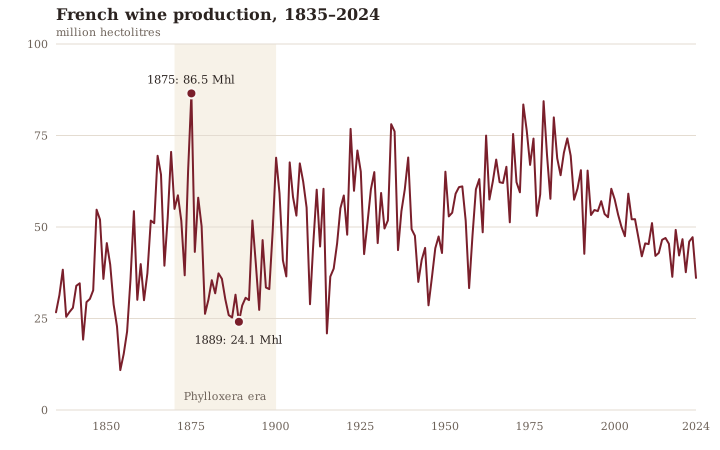
French production peaked at 86.5 million hectolitres in 1875. That harvest came from a vineyard at its greatest extent, at the moment the phylloxera aphid had begun to kill it at the roots. By 1889 production was down to 24.1 million hectolitres, less than a third of the peak and the lowest point of the crisis.
Replanting on grafted American rootstock brought volumes back. It did not bring back the vineyard of 1875. James Simpson's 2004 working paper on French domestic wine markets between 1870 and 1911 sets out why the shock spread beyond the vineyard: scarcity pushed prices up; high prices drew in imports and adulterated wine; and once the replanted vines came into bearing, the market swung into glut.
Across the twentieth century the line falls slowly, with sharp breaks along the way. It ends at 36.1 million hectolitres in 2024, a harvest smaller than anything the 1870s would have counted as normal.
The consumption collapse
This is the chart with the most direct consequences for the modern French wine economy.
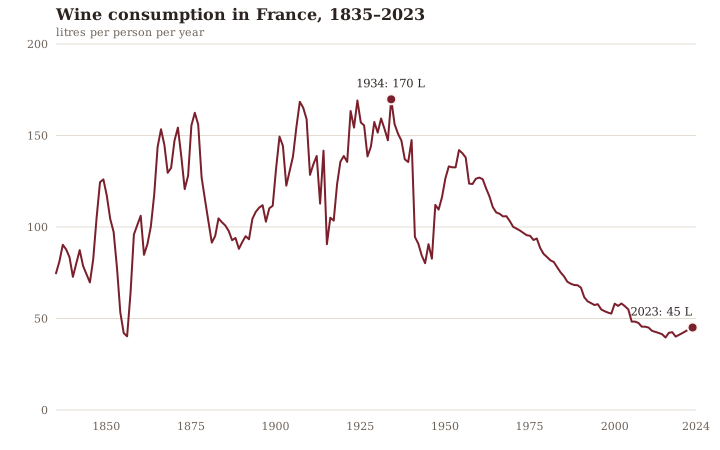
In 1934 French consumption stood at 170 litres of wine per person per year, nearly half a litre a day averaged over the entire population. In 2023 it was 45 litres. The fall is neither a dip nor a cycle. Almost three quarters of the domestic market disappeared over three generations, as wine went from a daily staple to something drunk occasionally.
Much of the present structure of French wine follows from this line: chronic overcapacity, pressure on prices at the entry level, and the industry's sustained focus on quality and on foreign buyers. Producers of ordinary daily wine lost their customers. Producers of wine that people choose to drink, rather than drink by default, kept what was left of the market.
The export pivot
The industry's response to the shrinking home market shows in the export share.
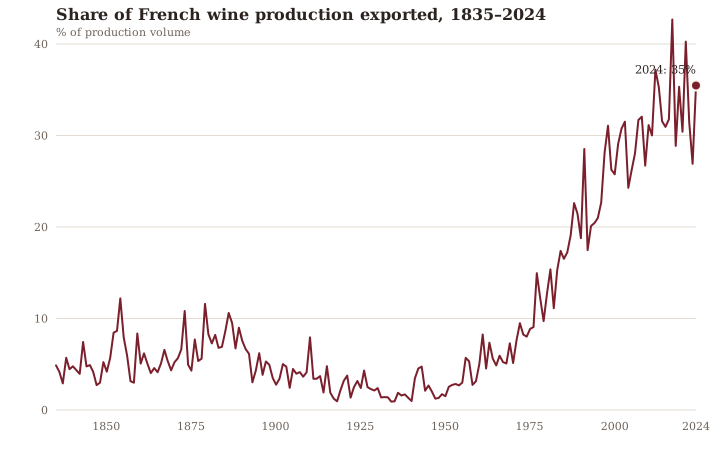
In 1900 France exported under 3 per cent of the wine it produced and drank the rest. In 1960 the share was still only about 5 per cent. By 2024 it had reached 35 per cent. In little more than half a century, an industry that sold almost entirely at home became one of the world's largest exporters.
For Bordeaux this reverses the inward turn of the nineteenth and twentieth centuries and returns the region to its older pattern. The port that shipped more than a hundred thousand tonneaux in 1308–09, much of it to England, spent the industrial era selling mostly to French buyers. The move to export brought back the orientation toward foreign markets on which the region had been built.
The shrinking vineyard
The last series measures land under vines.
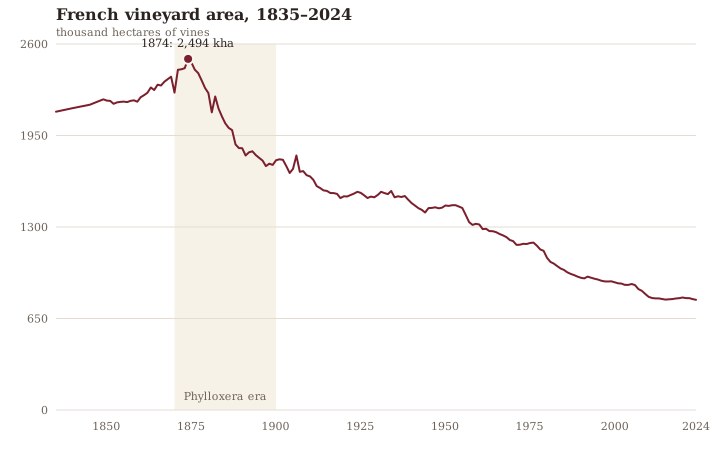
The French vineyard reached its maximum of 2,494 thousand hectares in 1874, on the eve of the phylloxera collapse. By 2020 it covered 799 thousand hectares, less than a third of that. The decline has had several causes in succession. Phylloxera killed vines that were never replanted. The fall in consumption made large areas of ordinary-wine vineyard unprofitable. Successive rounds of subsidised grubbing-up removed more.
Bordeaux is in the most recent round. With generic wine going unsold and demand falling, the Gironde has in recent years run organised arrachage (uprooting) campaigns that pay growers to remove vines permanently. For the growers involved it is a hard adjustment. Against the long series, it is the latest step in a contraction that has been under way for 150 years, not a sudden break.
Demand and the size of the vineyard
The historian Roger Dion argued in his Histoire de la vigne et du vin en France that the standing of France's great vineyards is a social and commercial fact before it is a geological one: markets made these regions. The Bordeaux figures fit that argument over seven centuries. The medieval export trade recorded by the Grande Coutume, the nineteenth-century boom and the phylloxera bust, the long decline of the domestic mass market and the turn to export all follow changes in who was buying. English buyers, then Dutch, then French, and now buyers worldwide have decided, in turn, what the Bordeaux vineyard produces and how much of it the region can afford to keep planted.
Sources
- Anderson & Pinilla, Annual Database of Global Wine Markets, University of Adelaide
- Sandrine Lavaud, Vignobles et vins d'Aquitaine au Moyen Âge (and related work on medieval Bordeaux)
- Margery K. James, The Fluctuations of the Anglo-Gascon Wine Trade during the Fourteenth Century, Economic History Review, 1951 (DOI 10.1111/j.1468-0289.1951.tb00607.x)
- James Simpson, Phylloxera, Price Volatility and Institutional Innovation in France's Domestic Wine Markets, 1870–1911 (IFCS WP wh044602, 2004)
- Roger Dion, Histoire de la vigne et du vin en France, des origines au XIXe siècle (CNRS Éditions)