The Great Crises
Rebuilt From the Roots: How American Vines Saved Bordeaux
After phylloxera, Bordeaux was replanted vine by vine on American rootstock. The dead ends, the grafting debate, and the 41B that beat limestone chlorosis.
Phylloxera was never cured. Once it was clear that the aphid could not be poisoned out of the soil, French growers had two options: give up the vines, or replant them on roots the insect could not kill. Bordeaux replanted. Historians call the process the reconstitution, and it was the largest agricultural project the region had ever undertaken. It changed which vines were grown as well as how they grew, and almost every row in the Gironde today descends from it.
The dead ends
Grafting did not win at once. For about twenty years growers tried remedies that worked in some places, for some people, and that partial success is why the argument lasted so long.
The strongest chemical option was carbon disulfide (sulfure de carbone), a volatile liquid injected into the soil to gas the aphid at the root. Baron Paul Thénard promoted it. Applied properly, it killed phylloxera, but only in open, fertile soils, and the equipment, the chemical and the labour cost more than most growers could pay. Potassium sulfocarbonate, a related compound, was gentler and had the same limits.
Submersion worked too. Flooding a vineyard for several weeks every winter drowned the insect. It required flat, low-lying land close enough to water to be flooded on demand, which described a small fraction of the Gironde.
Growers also noticed that vines in deep sand were left alone, because the aphid could not travel through loose grains. But no one could move a vineyard onto sand it did not have. Each of these remedies depended on a soil or a site that most estates did not have, and none of them could replant Bordeaux.
The américanistes
The remedy that could came from a faction the trade called the américanistes. Their reasoning started from the insect's origin. Phylloxera had arrived from North America on imported American vines, and those vines, having evolved alongside it for millions of years, survived it. Join the European vine, Vitis vinifera, productive but defenceless, to an American root, and the plant might keep its European fruit while gaining American resistance underground.
The idea took shape around Montpellier. In July 1868 the regional agricultural society appointed a three-man commission to investigate the dying vineyards: Gaston Bazille, grower and president of the society; the botanist Jules-Émile Planchon; and the winegrower Félix Sahut. Planchon carried the grafting solution forward. He worked with Charles Valentine Riley, the American entomologist who knew the aphid from Missouri and knew which American vines tolerated it, and in 1873 he travelled to the United States to see the resistant vines growing. Bazille and the grower Léo Laliman had separately made the same proposal: graft French tops onto American roots.
The French government had offered a prize of more than 300,000 francs for a cure. Laliman applied for it and was turned down, on the grounds that he had found a way around the blight rather than a cure for it. The ruling was accurate. The reconstitution saved the vineyard without ever defeating the insect.
The américanistes won over several congresses, not by decree. At the international phylloxera congress in Montpellier in 1874, grafted vines on American roots were shown bearing European fruit. Opposition was real: growers distrusted foreign roots, and chemists kept faith with carbon disulfide. The numbers settled it. Chemicals bought time on a minority of sites, while grafting gave any grower a vineyard that would live.
Grafting against direct producers
Accepting American roots opened a second dispute. One option was grafting: keep the classic European varieties unchanged and set each scion onto an American rootstock. The other was to replant with direct producers (producteurs directs), new hybrids crossed from European and American species that carried their own resistance and grew on their own roots with no graft at all. They were cheaper, hardier and simpler to grow. At their peak, in the first half of the twentieth century, they covered close to a third of France's vineyard.
The trade judged their wine coarse. In a region that sold on reputation, that verdict ended the discussion. Bordeaux, like the other fine-wine regions, chose grafting and paid the extra cost to keep Cabernet, Merlot and the rest of its varieties unchanged in the glass. Hybrids were pushed to the edges of the vineyard and eventually out of quality production. For the next century French fine wine rested on the same arrangement: noble varieties above ground, American roots below, joined at the graft.
Chlorosis and 41 B
The next question was which American rootstock to use. The first ones, taken from Vitis riparia and Vitis rupestris, resisted phylloxera well but failed on limestone. Much of the right bank, Saint-Émilion, Pomerol and the côtes, sits on limestone, and there these roots developed lime-induced chlorosis. Active calcium carbonate in the soil blocked the vine's uptake of iron, the leaves yellowed, and the plant declined. A rootstock killed by the soil was no improvement on a vine killed by the aphid.
A third American species solved it. Vitis berlandieri grows wild in the limestone hills of Texas and tolerates chalk. Some of the plants used in France were collected and shipped by the Texan horticulturist Thomas Volney Munson, whom the French government awarded the Mérite Agricole in 1888. Berlandieri resisted both the aphid and the lime, but it rooted and grafted poorly on its own, so breeders crossed it with other vines.
In Bordeaux in 1882, Alexis Millardet and Charles de Grasset crossed the vinifera grape Chasselas with berlandieri. The result entered the catalogue as 41 B. It tolerates up to about 40% active limestone, and it allowed growers to replant the chalkiest slopes. It is still the standard rootstock for limestone in Cognac, Champagne and Bordeaux. Millardet, a professor at Bordeaux, also formalised the copper-and-lime spray known as bouillie bordelaise three years later, so the same scientist supplied answers to two of the region's three plagues.
A vineyard remade
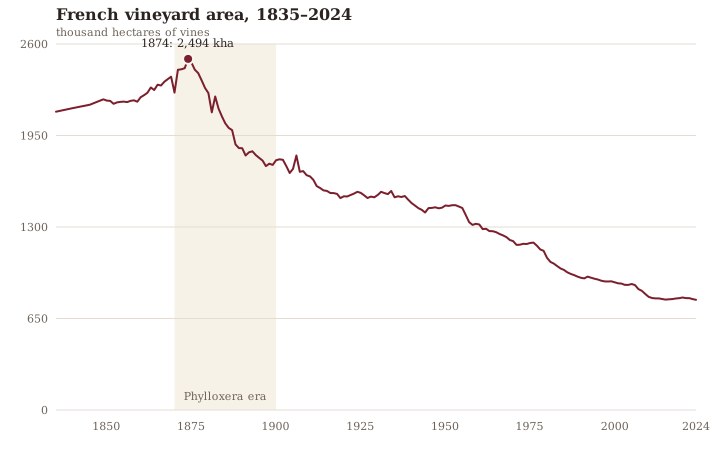
Reconstitution was slow and very expensive. Every living vine had to be pulled up and replaced with a two-part plant, raised, grafted and established before it bore a single grape. That meant years of spending before any return, on every hectare in the Gironde. By 1900 roughly two-thirds of France's vineyard stood on American roots. The long series below shows the vine area recovering after the collapse of the 1870s and 1880s.
A grower replanted once in a generation, so the choice of variety was made with care, and those choices narrowed the region's range of grape varieties. Varieties that took badly to grafting declined. Malbec, known locally as Côt, had long been a Bordeaux staple, but it grafted awkwardly and set fruit unreliably. Growers paying heavily to rebuild had little use for an erratic vine, and they replaced it steadily with Merlot, which grafted well, cropped more generously and is now the most planted grape in Bordeaux.
The reconstitution did not settle the varietal order on its own. Later events, the severe frost of 1956 among them, finished what it started. It did set the direction. The vineyard that came out of it was more uniform, planted to fewer varieties, and growing on roots from another continent.
Sources
- Gilbert Garrier, Le Phylloxéra — une guerre de trente ans, 1870–1900 (Albin Michel, 1989, ISBN 2-226-03879-5)
- Great French Wine Blight — Wikipedia (Montpellier commission, Riley, Laliman, the government prize)
- 41 B Millardet et de Grasset — Plantgrape (IFV/INRAE), on parentage and active-limestone tolerance
- Pierre-Marie-Alexis Millardet — Wikipedia (Bordeaux professor, rootstock breeding and Bordeaux mixture)
- Thomas Volney Munson — Wikipedia (Texas Vitis berlandieri, Mérite Agricole 1888)
- Anderson & Pinilla, Annual Database of Global Wine Markets, University of Adelaide